Why I'm Optimistic About the AI Future
I get asked this all the time: is AI going to ruin everything? Here's my honest answer — yes, the transition will hurt some people, and yes, I'm still genuinely hopeful. Here's what I tell people who ask.
 Fabian Mösli
 Reading Preferences
Key Takeaways
- • Every big technology sparked the same panic — printed books, trains, the telephone, the calculator. The disruption was real and uneven every time, but we adapted, reorganised, and ended up glad it happened. Adapting is the thing we're actually good at.
- • AI is already changing science fast. AlphaFold cracked a 50-year protein problem, GNoME predicted 2.2 million new materials, and this is only a couple of years into serious deployment. I expect real progress on cancer, Alzheimer's, and fusion within my lifetime.
- • You can't form an honest opinion about AI from articles about AI, or from one casual chat with a free model. Use frontier tools daily, invest in your ability to keep learning, and strengthen the parts of you that machines can't copy.
In this guide
In my circles I’m known as the AI guy. So I get asked the question a lot, usually over a beer or near the end of a dinner: “Be honest. Are we screwed, or is this going to be good?”
I never know exactly what people want from me when they ask. Sometimes they want permission to be afraid. Sometimes they want a reason to stop being afraid. Often they just want to know if I’m afraid, since I’m the supposed expert in the room and that would be a useful data point.
So here is my honest answer. I’m a tech optimist. Not in a “look on the bright side” way. In a “I’ve thought about this a lot and the math, for me, comes out on the side of hope” way. There will be pain. There will be people who get badly hurt by what’s coming. But I think we’re walking into a genuine golden age of knowledge and discovery, and most people aren’t quite letting themselves see it yet.
Let me explain why.
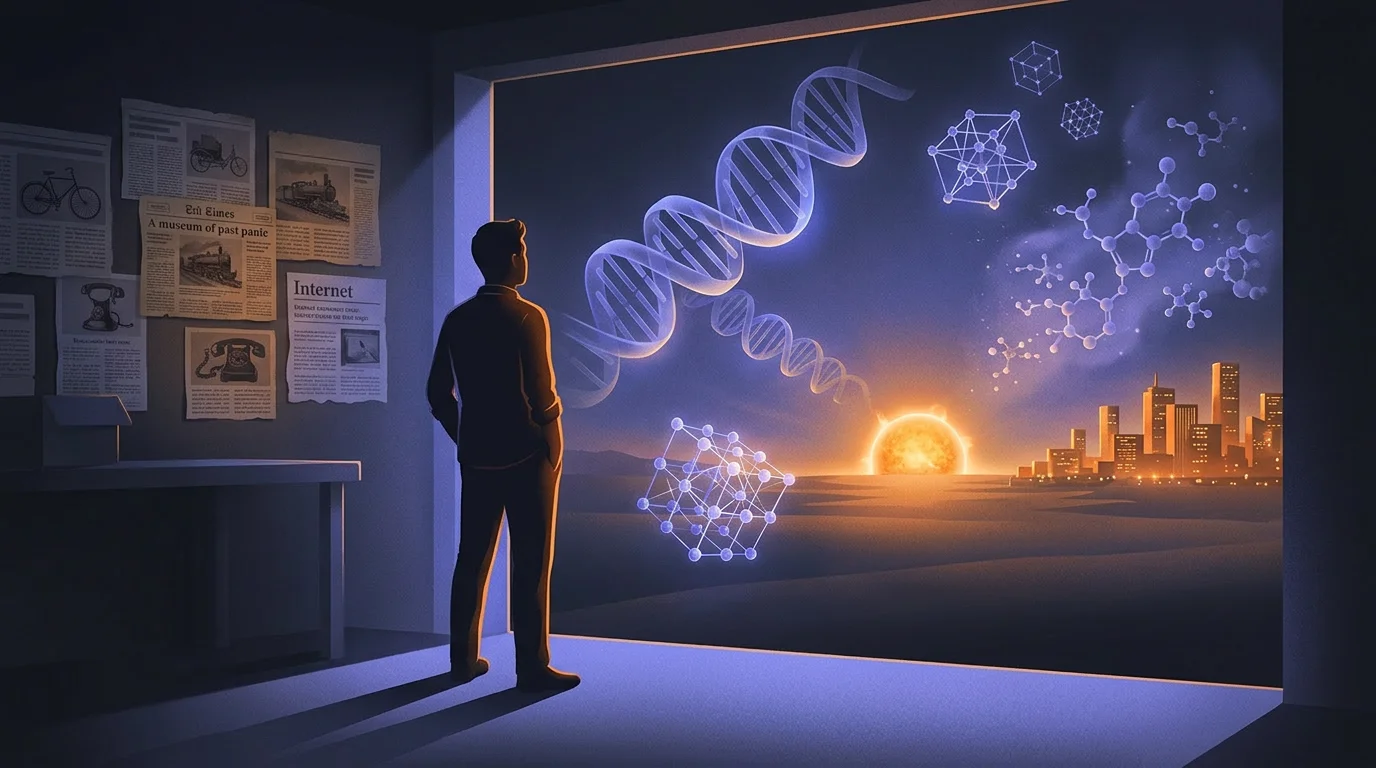
The hilarious museum of past panic
There’s a website called the Pessimists Archive that I think every adult should spend an afternoon with. It collects, lovingly, the newspaper clippings and op-eds that greeted essentially every important technology in modern history.
A few of my favorites:
- The Swiss scientist Conrad Gessner warned in 1565 that the flood of printed books would be “confusing and harmful” to the mind. There was simply too much information. People would lose the ability to think.
- Doctors in the 1890s coined the term “bicycle face” — a permanent expression of strain that women cyclists were allegedly developing. Some medical journals warned that cycling would cause infertility.
- When trains first arrived, there was genuine concern that the human body wasn’t built for travel above 30 miles per hour and that passengers might suffocate or have their organs displaced.
- Critics of the telephone in the late 1800s argued it would destroy human relationships. Why would anyone bother to visit a friend if they could just call?
- Television in the 1950s and 60s was going to rot children’s brains and end the practice of reading.
- Pocket calculators in the 1970s were going to leave a generation of students unable to do basic arithmetic. (You can still find math teachers who’ll argue this one wasn’t entirely wrong, which I respect, but the doom didn’t quite arrive.)
Every time, civilization survived. Every time, the new technology brought real downsides, some serious. But the doom didn’t arrive. We adapted, rearranged ourselves, and eventually couldn’t imagine going back.
This isn’t a knockdown argument. “It worked out before” is not proof it’ll work out this time. But the pattern matters. Every generation is convinced that their technological transition is the one civilization can’t survive. They are convinced because the fear feels real in the moment, and because we are notoriously bad at imagining how we will adapt to something we haven’t adapted to yet.
”But surely AI is different”
I take this objection seriously. AI is not a bicycle. It is not a calculator. It can do things — write, reason, code, decide — that previously required a human mind. There is a category difference here worth respecting.
But I think the difference is less about kind and more about speed. Every previous technology forced humans to learn new skills, abandon old ones, reorganize their work and lives. AI forces the same thing, just much faster. That is the genuine challenge, and where I think the real pain is.
Because I want to be clear: there will be pain. Pretending otherwise would be insulting.
Some jobs are going to vanish before the people doing them have time to pivot. Some industries are going to transform faster than anyone in them can comfortably keep up. People who built their careers on a particular skill that AI now does well are going to feel that ground shift under them. That is real, and it deserves seriousness, not optimism-as-dismissal.
What I push back against is the leap from “this transition will hurt” to “this technology is bad.” Those are different claims. The printing press hurt the scribes. The car hurt the horse-and-carriage makers. The internet hurt the travel agents. None of those technologies were bad. They were just disruptive, and the disruption was uneven.
The honest sentence is: AI will probably be the biggest reshuffling of work and knowledge in our lifetimes, the pain will be unevenly distributed, and we will still be glad it happened.
Why I think we’re walking into a golden age
This next part is the one I find genuinely thrilling, and the one most public conversation undersells.
For most of human history, the bottleneck on what we can understand has been our brains. We can only hold so much in working memory. We can only read so many papers. We can only run so many experiments. The universe is staggeringly complex — molecular biology alone has more moving parts than any single person could ever carry in their head. We’ve made enormous progress in spite of that bottleneck. But the bottleneck has been real.
For the first time, we have tools that can carry more of that complexity than any human ever could. They can read every paper. They can hold every protein structure in memory. They can simulate molecules, weather, economies, materials. They can notice patterns across disciplines that no individual researcher would ever connect, because no individual researcher reads in twelve fields at once.
That changes science. Not slowly. Fast.
A few things I’d point to that have already happened:
- In 2024, Demis Hassabis and John Jumper of Google DeepMind shared the Nobel Prize in Chemistry for AlphaFold, which essentially solved a problem (predicting the 3D structure of proteins) that biology had been stuck on for 50 years. AlphaFold has now published structures for over 200 million proteins — basically every protein known to science. Drug discovery teams that used to spend years just figuring out the molecule’s shape now start there on day one.
- Insilico Medicine’s INS018_055, a drug for pulmonary fibrosis whose target and molecule were both AI-designed, became the first end-to-end AI-discovered drug to reach Phase 2 clinical trials. It is the first of what will be many.
- DeepMind’s GNoME system, published in Nature in late 2023, predicted 2.2 million new stable crystal structures — somewhere around 800 years’ worth of human materials science, done in a few months. Materials matter for batteries, solar panels, semiconductors, fusion containment, basically everything physical.
- Their GraphCast weather model outperforms the traditional supercomputer-based forecasts on most metrics, while running thousands of times faster.
- In December 2022, the National Ignition Facility in California achieved fusion ignition — the first net energy gain from a fusion reaction in human history. AI is increasingly central to designing reactor geometries and predicting plasma behavior.
None of this is science fiction. It already happened. And we are maybe two or three years into the serious deployment of frontier models. What happens when this compounds for a decade?
I keep thinking about my own life. I’m 41. If I’m lucky enough to live a normal lifespan, I expect to see:
- Meaningful progress against multiple cancers, possibly the eradication of several of them
- Real treatments — not just delays — for Alzheimer’s and Parkinson’s
- Practical fusion energy, or something very close to it
- Personalized medicine that finally delivers on the promise it has been making for twenty years
- Probably some genuinely large surprises that nobody on social media is currently predicting
If that is “dystopia,” I will take it.
The Roy Amara correction
There’s an idea called Amara’s Law, after the futurist Roy Amara:
We tend to overestimate the effect of a technology in the short run and underestimate the effect in the long run.
I think about this constantly. The short-run AI hype is mostly nonsense. AI is not going to replace your CEO this year. ChatGPT is not going to write the next great novel. Your job is probably safe through next quarter.
But the long-run impact is going to be far bigger than even the maximalists are currently saying. Most people are calibrated to the short run because that’s what social media optimizes for, so they end up doubly miscalibrated: too excited about the next six months, too bored about the next twenty years.
The right framing, in my opinion, is the inverse. Be skeptical of any product that promises to change your life next quarter. Be deadly serious about what compounds over a decade.
How to sit with the uncertainty
If you’ve read this far, you might be wondering what to actually do with all this. Especially if you are not the AI guy at parties and you don’t get to think about this stuff all day for work.
A few thoughts. None of them are original; most of them I learned from people who have been thinking about technology longer than I have.
Use the tools yourself, even if you don’t think you need to
If you only take one piece of advice from this whole piece, take this one. You cannot form an honest opinion about AI from articles about AI. The only way is hands-on, ideally daily.
I want to be direct here, because this is the part where I most often disagree with smart, skeptical people, and where I suspect quite a few readers might quietly recognise themselves. The pattern goes like this. You opened the free version of a consumer chatbot. You typed a vague question. You got a mediocre, weirdly confident answer that was wrong in some obvious way. Maybe you tried two or three more times, hit similar walls, and came away with a settled view: this is overhyped, the emperor has no clothes, my work is safe. I get the appeal. It’s a clean story, and it lets you stop worrying. It’s also built on a tiny sliver of what AI actually is in 2026.
If your only exposure has been a casual chat with whatever model was free on a webpage, here are some things you probably haven’t bumped into yet:
- The model you tried is almost certainly not the model that people doing serious work are using. There’s a meaningful gap between consumer defaults and what’s actually available at the frontier — sometimes hidden behind the same product name.
- How you set the thing up matters enormously. The bare model is like a brilliant new hire locked in an empty room. Give it the right context, custom instructions, memory of your project, connected tools, the right harness around it, and it stops feeling like clever autocomplete and starts feeling like a colleague. I wrote about this shift separately.
- Large language models are not the final form of AI. They’re one type. There are image models, video models, voice and audio models, scientific simulators, planning systems, agents — all with very different strengths. The most interesting work right now is happening when these get combined. Much the way your own brain isn’t one homogeneous thing, but a working society of specialised systems, none of them especially smart in isolation, that together do everything you do.
Looking at a single chatbot reply and concluding “this isn’t intelligent” is a bit like looking at one neuron and concluding “this isn’t a person.” Strictly true. Missing the level the actual story is happening on.
This is exactly where Paul Krugman tripped, back in 1998. The Nobel-laureate economist wrote that the internet’s economic impact would be “no greater than the fax machine’s.” Krugman isn’t stupid. He’s one of the smartest economists alive. He just hadn’t spent enough time inside the thing to have a calibrated view, and he made a confident prediction anyway. The same trap is wide open today, and a lot of smart, busy, accomplished people are walking straight into it.
I wrote separately about how I actually built the habit. The short version: pick one tool, use it every day for a month, properly — not in passing — and the fear-versus-hope ratio in your head will calibrate itself.
Invest in adaptability, not credentials
Alvin Toffler, writing in Future Shock in 1970, made a prediction that has aged better than most: “The illiterate of the 21st century will not be those who cannot read and write, but those who cannot learn, unlearn, and relearn.”
That is the actual skill of this era. It isn’t “knowing AI.” It’s being someone who can keep absorbing change without getting brittle. The specific tools will turn over every two years. The capacity to keep learning will not.
Strengthen what’s uniquely human in you
Your relationships. Your taste. Your physical health. Your ability to listen to another person and actually understand them. Your sense of humor. These are not just nice-to-haves.
As more and more cognitive work gets compressed by machines, the parts of you that aren’t replicable become more valuable, not less. Take care of them like you would a savings account. Show up for the people who matter. Read things that are not about AI. Get enough sleep. Develop a real opinion on something, anything, that you came to honestly.
Be a learner, not a defender
I notice that the people who fight AI hardest are usually the ones working hardest to prove it can’t do something. They post the failures, collect the embarrassments, wait for the bubble to burst. Some of that is fair criticism. A lot of it is emotional defense against the discomfort of having to learn something new.
You don’t have to do that. You can just learn the thing. It’s slower in the short run and much faster in the long run, because you are no longer fighting the current.
Don’t try to predict — try to participate
Alan Kay said it best, in 1971: “The best way to predict the future is to invent it.”
You don’t have to invent anything world-historic. You just have to participate in the building of your own corner of the future. Build a thing. Use a tool to do something you couldn’t do before. Teach someone what you learned. Have a real conversation with a colleague about how to use this stuff well at your company. That’s it. That’s the move.
Where this is coming from
None of this comes from any special vantage point. I’m not a futurist. I don’t have a grand theory of technology. I build AI systems to get real work done — at Carewell, and on the side projects I care about — and then I use them, every day. Using them is what shows me where they fall short, and that’s what shapes the next round of building. The reason any of this interests me isn’t that AI is flashy. It’s what it makes possible for people who didn’t have these tools before. The rest of my time, I spend reading more than is probably healthy and thinking about where all of this is going.
What I do know, I worked hard for. I kept going when things broke for reasons I didn’t understand, when the answer wasn’t online yet, when I was visibly bad at the thing I was trying to do. And a huge part of what I think now, I owe to a community of people on the internet who share what they’re learning with real generosity — tips, weird experiments, the things that didn’t work, the things that surprised them. Most of what I’ve been inspired to try started with something one of them posted. I’d be much further behind without them.
But maybe that’s enough. Most of the loudest voices on AI’s future are selling either fear or utopia, and neither feels honest. What I’ve landed on, after a few years of being elbow-deep in this stuff, is closer to: this is going to be hard, it’s also going to be incredible, and the best thing you can do is participate rather than predict.
The future is being built right now, in real time, by people no smarter than you. You can be in the workshop, or you can be in the audience.
I know which one I’d rather be.
Published: 2026-05-19
Last updated: 2026-10-03